Chapter 1: The Inheritance
The moors trembled beneath a waning moon as Eleanor arrived at Wythewood Hall. The mansion, draped in moss and sorrow, brooded atop a hill, windows like lusterless eyes set deep within a crumbling skull. The lawyer’s voice still echoed in her ears: “A distant aunt, an unexpected gift. It is yours, Eleanor.” She’d thought it luck—until she saw the house.
Door hinges croaked her arrival. The air inside, stagnant as a tomb, tasted faintly of withered violets and old secrets. Portraits lined the walls, their subjects faded, averted, as if unwilling to witness her trespass.
Rooms unfolded: high-ceilinged, somber, filled with shadows that slithered shyly behind antique furniture. No footsteps but her own. No laughter, ever. In the small hours, Eleanor wandered the labyrinthine hallways, the silence a heavy, throbbing thing pressing at her eardrums. She barely slept, haunted by whispers she could not trace.
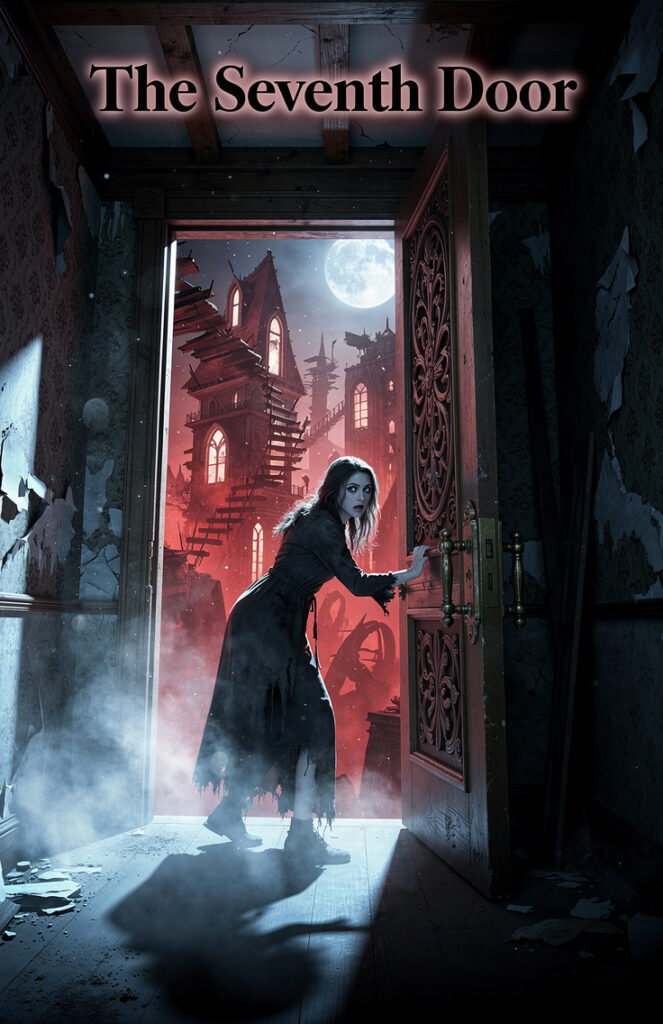
On the third night, a draft caressed her in the narrow east wing. She paused before a wall she’d passed countless times—and now, impossibly, stood a door. Its wood gleamed with a phantom luster, and the air about it pulsed, beating—a heart behind ancient timber. Her hand trembled as, inexorably, she reached for the handle.
Chapter 2: The Door Unveiled
The handle was cold, far colder than the humid June night warranted. Eleanor’s fingers curled around it, half-dreaming, half-afraid. She pressed her ear to the seam. Nothing—no whispers, no echo of old footsteps. Only silence so thick she thought she heard her own blood threading through it.
The door groaned open, soundlessly save for the rush of stale air, peppered with dust and musk. It opened not upon another part of Wythewood Hall, but onto a corridor foreign and endless, clothed in charcoal gloom. Candle sconces flickered with sickly blue flame, casting unstable shadows. She crossed the threshold, the wood instantly sealing behind her with a breathless sigh.
All about her, the house felt different: larger, breathing, alert. Portraits leered from the walls, eyes painted black, gazes fixed unrelentingly forward. She walked, drawn onward by a melody threading through the cold—a music box tune, piped thin and warped. Hallways looped impossibly onto themselves, and her own footsteps echoed too many times, as if unseen shapes trailed her path.
When she turned to seek escape, the door was gone. Only wall—slick with something damp—remained. Heart pounding, Eleanor realized she had not trespassed into a room, but into a world unraveling within the mansion’s bones.
Chapter 3: The Voices in the Walls
As Eleanor pressed onward, the corridor constricted, the air thickening with unseen tension. Every step her shoes made was answered faintly by a skip-step echo, quick and sly, trailing in her wake. The music box grew louder, the notes now a fractured lullaby that burrowed into the hollows of her skull.
She paused beside an ornate mirror. Its glass was clouded, as if long neglected, yet her own reflection pulsed within—pale and anxious, but something else hovered behind it. A face, or the memory of one, mouth frozen wide as if forever whispering.
“Hello?” Her voice dissolved into the gloom, answered by a chorus of sighs and murmurs seeping through the wood and stone. Names hissed by unseen throats pooled in her mind: “Lavinia… Edmund… Eleanor…” She recoiled as her own name slithered down the hall, half-hope, half-mocking.
A sudden wind battered the lamps, threatening to snuff them out. At her back, a door rattled, though none was visible. Eleanor’s skin prickled with dread. Were the walls themselves alive, shuddering with the memories and regrets of all they had ever held?
She turned a corner, and for an instant, beheld a figure hunched at the corridor’s end—motionless and cloaked in black, watching her with timeworn patience.
Chapter 4: The Keeper’s Warning
He did not move, yet the air bent in warped anticipation. He wore Wythewood’s dust and sorrow as a mantle, his features lost beneath the brim of a moth-eaten hat. Eleanor summoned the strength to speak.
“Who are you?”
His voice slithered from the shadow, brittle as fallen leaves: “I am the Keeper of Crossing Doors. You’ve trespassed where memory and forgetting entwine.”
She backed away instinctively, but the walls seemed to press closer. “What is this place?”
He let silence bloom between them, studying her. “Wythewood is more than timber and stone. Some doors are meant to remain hidden, Miss Hale. Not every inheritance is a blessing.”
“What’s through here?” she asked, trembling.
“Loss,” he replied. “Reflection. Truth, festering deep. Open another door, and you will descend further. Only you can choose to turn back, but every passage you cross… less of you returns.”
The lamp flickered, conflagrated by a chill wind. Eleanor searched behind, but already her footprints faded into the swallowing darkness. She met the Keeper’s gaze, and in his eyes glimmered both mercy and the promise of herself undone.
He bowed, dissolving into shadow, leaving her with only the door—now pulsing like a wound—begging to be opened once more.
Chapter 5: Descent
Compelled by dread and fascination, Eleanor’s trembling hand pressed open the next door. She tumbled into a gallery swaddled in fog, ceiling lost in looming shadows where silent chandeliers hung, faceted with weeping wax.
Portraits here wept oil down their faces—countenances she recognized from the mundane world, now twisted and broken by grief. Her ancestors, their eyes beseeching. Each painting’s frame bled darkness onto the marble floor.
A voice—her own voice—echoed high above: “Go deeper. Know them. Know yourself.”
She groped forward, passing halls without windows or doors, yet every turn offered another slick, unseen entrance. Whispers clung to her. The air grew thick, oppressive with the scent of dying roses and old candle smoke.
Hands unseen brushed her cheek, icy and lingering, as if longing to remember the warmth of flesh once more. The floor beneath her feet softened, then pulsed—a living, wounded thing. Behind her, the doors vanished, replaced by a pulsing heartbeat within the stone.
It dawned on Eleanor, horror lancing through her: every step forward was a retreat from reality. Every opened door stitched this place tighter around her soul, weaving her story into Wythewood’s tapestry of echoing gloom.
Chapter 6: The Echo Chamber
Eleanor wandered into a vaulted room where whispers ricocheted in endless lamentations. This was the echo chamber—a sanctum of memories ground to powder by the centuries’ grind. Silver threads drifted in the air, suspending fragments of voices, laughter, and screams.
Shadows on the walls flickered, reenacting scenes from lives collapsed into regret. She glimpsed her own sleepwalking eyes, seen through another’s gaze. She beheld childhood: her mother softly humming, a white dress, her own hands outstretched. Then—rippling, twisting—the vision soured, her mother’s face melting away, replaced by unfamiliar, hollowed strangers.
Grief twisted in her chest. She stumbled and fell to her knees upon the shifting floor, cool and soft as wetted ash. From the shadows, the Keeper reappeared, sorrow carved deep in his features.
“It is not Wythewood that is the labyrinth,” he muttered, “but the haunted corridors within yourself. They will beckon you further.”
A sudden pounding rose in her chest; the chamber thundered with the beating of forgotten hearts. Eleanor pressed her palms to her ears, fugitive from her own inescapable past. The door at the room’s far end pulsated, gold light oozing from beneath, summoning her onward into ever darker recesses.
Chapter 7: Through the Keyhole
Eleanor drew near the pulsing door, uncertainty festering in her stomach. The keyhole bled a flickering, sickly gold. A single, antique key dangled from a velvet ribbon, nailed into the wall. Her hand—no longer wholly her own—lifted the key and slid it home.
The door yawned wide with a sigh. What lay beyond was no mere room, but an endless void stitched with brittle, floating islands—the remnants of long-forgotten dreams. A single bridge, etched with runic symbols, snaked into nothingness, trembling under a faint wind that carried the scent of burning lilac.
Atmosphere here was thin, taste of copper and fear on every breath. She advanced. On the farthest island hovered a chair, and in it, herself—older, hollow-eyed, grey with time’s touch, lips bent in a private, silent scream.
She approached the doppelgänger. Its eyes snapped open, black and infinite. In its lap was the family ledger, pages inscribed with names crossed and bled into by ink. “Know the truth,” it whispered, voice like splintered glass. “Each reality you cross feeds the house, and now you are woven into its walls.”
The door behind Eleanor vanished with a final, resigned hiss.
Chapter 8: The Feast of Shadows
Wythewood’s heart was a banquet hall shrouded in velvet black. A colossal, grotesque table groaned under the weight of rotted fruit, silver platters writhing with eels. Seated nearby, spectral figures dined in ritual silence—her ancestors, faces empty, hands skeletal.
At the head of the table sat the Keeper, mask in place, chalice raised in solemn greeting. “Sit, Eleanor. Every heir must dine, lest the house hungrily devour what remains.” His voice rippled through the cold, thick air.
She took the empty chair, forced by nameless gravity. The guests inclined their heads, acknowledging her, before resuming their spectral feast. Rotten fruit split open, revealing phantoms writhing inside—her regrets, her failings, memories half-remembered but now laid bare.
“Eat,” the Keeper intoned. “Only through acceptance of loss does the maze loosen its grasp.”
She tasted the fruit: bitter as betrayal, sweet as lost love. Memory flooded in—the death of her mother, the brusque way she closed herself off, the longing for belonging amidst absence. Tears welled, unwelcome but healing.
The room blurred, shadows withdrawing. The Keeper lifted his mask to reveal a mirror—her own reflection, eyes wide. At last, she saw herself clearly.
Chapter 9: The Final Threshold
The hall dissolved, and Eleanor found herself in the room where it all began: Wythewood’s east wing, before the impossible door. The air thrummed with the memory of every passage, every wound both old and fresh. The door was different now: glassy, rippling, its surface awash with glimmers of all the selves she had been and might become.
“You have seen the heart of loss,” the Keeper’s voice echoed—no longer from a figure, but within herself. “The choice remains—linger in the labyrinth of memory, or open the door and step forward.”
Eleanor’s hand hovered over the shimmer. Her pulse pounded its own war-song, a defiant plea in the haunted gloom. She saw, stretched across the threshold, all she had borne, all she had run from. No ghosts shrieking, only the silent witnesses of her grief, watching, waiting.
She breathed courage, cool and shuddering, and reached for the handle. As she gripped it, the door pulsed warmly—no longer a trap, but an invitation.
Steel-eyed, Eleanor turned the knob, crossing from darkness into the world she so longed to reclaim.
Chapter 10: Reclamation
Eleanor blinked, breathless. Morning sunlight washed through the east wing, painting Wythewood Hall in soft gold. The phantasmal chill ebbed, and silence reigned—gentle, not oppressive. She turned; the forbidden door was gone, as if it had never existed.
She reached out, her hand unmarked, yet changed forever. The portraits she passed now bore their age with quiet dignity. Shadows retreated to their corners, respectful and tamed. The sorrow of the house had eased, and something akin to hope fluttered in her chest.
Outside, the moors waved beneath a sky brightening with day. The air tasted of rain and beginnings. Eleanor inhaled deeply, grounding herself in the present—the ache of loss still sharp, but now tempered with acceptance.
She knew, with a quiet certainty, that the mansion’s darkness would linger at its edges, waiting. But so, too, did the light. Wythewood pulsed with the stories of those who passed through its doors, each made whole by facing the unseen, the unspoken, the feared.
Eleanor stepped forward—herself again. The mansion welcomed her, no longer a prison but a home stitched with shadow, memory, and the fragile promise of new dawns.