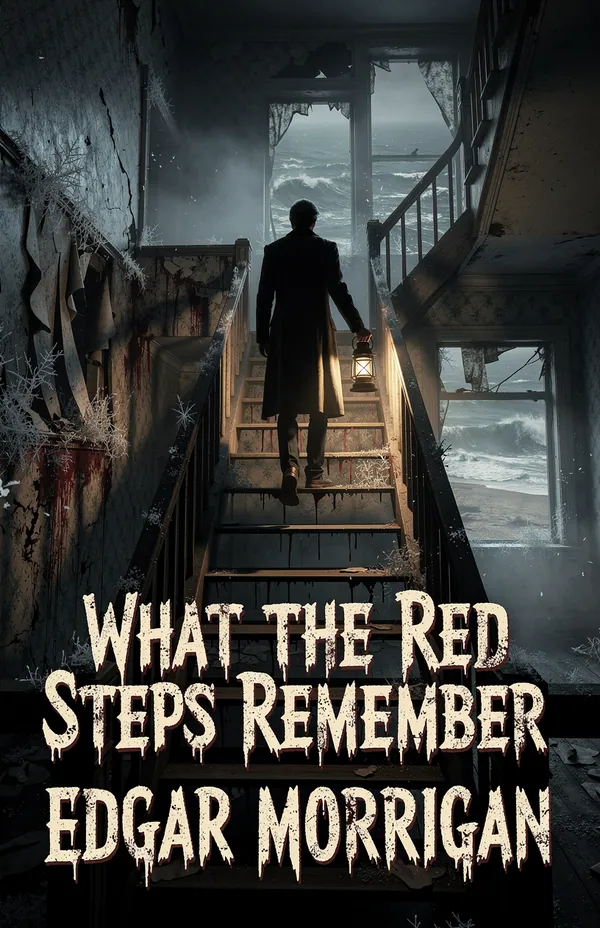
What the Red Steps Remember
Storyline
A series of blood-soaked steps leads a curious historian into the depths of an old, forgotten mansion where every floor seems to change with the turn of a century.
Chapter 1: The House on the Coast
The car came to rest on gravel that had not felt tires in years, and Elias Vance stepped out into a wind that smelled of salt and old smoke. Ashwood House stood against the grey sky like something remembered rather than seen, its windows crusted white with salt, its stone dark with damp. The lawyer met him at the door, pressed cold keys and a ledger into his hands, said the client wanted a full inventory, and drove away before Elias could ask a single question.
He walked the ground floor alone. Mildew furred the plaster. Furniture sat under sheets like a household holding its breath. In the back hallway the boards creaked with each step, and then he saw them. Dark stains, thin and spaced, leading toward the main staircase. His training said varnish, or perhaps rust weeping from old pipes. He knelt and touched one. It was tacky, faintly warm. At the foot of the stairs, a single step wore a red tinge. He opened his notebook and began to write.
Chapter 2: The Stains That Should Not Be
The stains held their shape under the beam of his torch, small ovals spaced like a child's game of stepping stones, and when he pressed a gloved fingertip to the nearest one it came away with a thin film that caught the light. Fresh. He wrote it down twice, as if repetition might make it sensible. The house had been sealed for forty years, the lawyer had said so, yet the wood beneath the mark was damp and the air above it carried a warmth that did not belong in a hallway full of mildew. He climbed the stairs because there was nothing else to do with a fact that would not fit, and with each step the light from the tall windows thinned, the cold settling into his knees, his wrists, the soft hollow behind his ears. Dust lay on the landing in a grey skin, and there, scratched through it, a twin furrow ran not up but down, a dragged weight scoring the boards toward the lower flight. The marks were old and new at once, and his reason, that patient clerk, offered rust, offered seepage, offered anything but the obvious. His torch beam trembled. Below, the stairwell swallowed the light whole.
Chapter 3: The Victorian Landing
The stairs ended not in damp stone but in carpet, a runner the color of dried wine, and the air turned suddenly thick with the smell of gas and cold ash and the tallow of cheap candles. Elias stood on a landing that had no business existing, his torch beam painting a papered wall of faded roses and a door closed tight against the dark. Behind it, a woman wept, low and steady, and a man's voice answered her, too quiet for words, a cold flat murmur that stopped the crying dead. He found the locket on the sill, a small oval of tarnished silver, and when his thumb touched the clasp the weeping ceased. The silence had a listening quality. He pressed his ear to the panel and heard only his own blood. He turned back to the stairs, and the red trail ran down them still, darker now, older, sinking into the grain as though it had been seeping there for a hundred years. The cold came up through his boots, and below, the next flight waited.
Chapter 4: Gaslight and Sorrow
The door gave under his palm before he had decided to push it, and the room beyond received him the way still water receives a stone. A long table, six chairs, a cloth gone the colour of old tea. The family sat at their meal with their hands arrested above their plates and their faces turned slightly toward a seventh place, empty, a small chair drawn up and a plate set before it as though the absent one might yet arrive. They were faint, these diners, thin as breath on glass, and the tallow candles burned without consuming. The smell of it folded around him, cold fat and old grief, and for a moment Elias could not remember the weight of his own name, only that he belonged here at this table and had perhaps always been expected. Then his lips moved of their own accord, reciting the ledger's flat inventory, chair, walnut, cracked rail, and the syllables were a rope he hauled himself along. The room thinned. The gas lamps guttered out behind him one by one, and the grey window light took everything, and the red trail sank on down the next flight, patient as a pulse.
Chapter 5: The Georgian Study
The next flight was narrow and unlit, and by the time Elias reached the bottom his torch had failed entirely, so it was candlelight that received him, a cluster of them burning in a brass stand on a desk of dark oak, and the smell of snuff and cold ash and wax. The study held its breath around him. Ledgers lay open, their pages soft with damp, and a letter rested half unfurled beside an inkwell gone to sediment, as though the writer had risen a moment ago and would return. He read by the nearest flame. A child taken by the sea, the words went, and a father who forbade the household to speak of it, who ordered the name struck from the books. The script was brown and careful. A small shoe sat by the hearth, warped with salt, its laces stiff. When he found the initials he already knew them. He crouched and touched the leather, and the floorboards were warm beneath his knees where the trail had thinned to a rust coloured thread.
A gust came off the water and every candle bent and died at once, and in the dark he found the next stairwell by touch, feeling for the faint warmth that pulled downward like a hand.
Chapter 6: What the Ledgers Kept
The pencil moved before he did, and he watched his own hand shape the letters of the dead man's grief, the loops widening, the capitals leaning backward into an older century, and when he stopped the word he had written was not in his own script but a brown and careful hand he had seen only on the page. He turned the notebook sideways as though an angle might explain it. Above him, footsteps crossed the ceiling, slow and deliberate, and he held still, and they held still, and the silence stretched until it was the only sound and then the steps moved on, unhurried, dragging something that scraped and paused. Elias set the pencil down and found the study mirror clouded at the edges with salt.
In the glass the room behind him was not the room. A narrow timber stair, iron hinges somewhere in the dark, and a figure in dark clothing standing with its back turned, not moving, not breathing. He counted to nine before he looked over his shoulder, and the room behind him was empty, and the mirror again held only his own grey face. He copied the letter anyway, every word, though his fingers ached with the cold. The warmth of the trail pulled him toward the landing and the narrow timber stair he had not yet seen.
Chapter 7: The Attic Door
The timbers took him before the door did. Rough hewn beams pressed close overhead, their grain raised by years of salt, and the plaster gave way to stone the colour of wet ash. The air changed in his mouth, tasted of smoke and the sea's raw breath, and the narrow stair bent him forward like a man walking into weather. Iron hinges showed in the dark ahead, a low door set into the stone, and beneath it the seam ran black where the trail pooled and thickened and stopped. He looked back once. The upward stairs stretched away longer than they had any right to, each step greyed with frost that had not been there, and the cold coming down them smelled of the present and of distance. He turned the choice over as he might turn a coin. Something in him, older than reason, said climb. The historian in him, the keeper of other people's losses, set his palm against the door. It gave way with a sound like a held breath released, and the smell of the sea flooded over him, drowning the last grey light of his own century.
Chapter 8: Seventeenth Century Stones
The door swung inward on a bare timber room, the ceiling low and ribbed with beams that wept slow beads of damp. Wind shouldered the shutters, and beyond stone the sea dragged its long grey chains across the shingle. A lantern guttered on a trestle, its flame thin and blue at the wick. He saw a cradle by the hearth, empty, its rockers still. A woman's shawl hung from a peg and did not stir. A man's coat lay across a stool, heavy and dark with spray, as though its wearer had only stepped out for a moment into the weather. The stains ended here, pooled at the boards beneath a salt-crusted window, and he knelt and touched the wood and found it warm. No voices rose. Only the wind, worrying at the casement, and somewhere below, the sea, that old and patient mouth. He understood then that the house was not haunted but holding, keeping a silence the way a fist keeps a coin, and that the blood was only the mark of it, the way grief leaves its print on a doorframe, worn smooth by a hand that would not stop reaching.
Chapter 9: Reading the Silence
He knelt there a long while, the cold from the boards seeping through his trousers, and the warmth beneath his palm persisting in a way that made him think of a hand pressed to a window long after the person has gone. The locket lay open in his other hand, its tiny portrait worn nearly smooth, and he spoke into the empty attic not loudly but in the flat tone of a man reading a catalogue entry he had finally understood. A child, he said, taken by the sea. A father who could not bear the name spoken. A mother who set a place at the table anyway, year after year, until the silence grew heavier than the grief. The wind dropped as he spoke, or seemed to, the casement settling into quiet, and the stain beneath his knees began to pale, drawing back from the boards like tide retreating, until there was nothing but clean grey wood and the smell of salt fading into dust. He closed the locket. When he turned, the stairs behind him were plain and unremarkable, and grey light fell down them from above.
Chapter 10: The Weight of the Past
Grey light fell down the stairs, plain and unremarkable. He climbed, and with each step the wood warmed and the salt smell thinned, the walls closing back into damp plaster, the windows crusting again with grey rime. At the ground floor the ledger waited where he had left it, its pages furred with mildew. He did not open it. He gathered his coat and the keys and set them on the hall table for the lawyer, then stepped out into the wind.
On the train he watched the coast recede, grey headlands folding into grey water. In his pocket the locket pressed against his thigh, small and cold. He turned his own hands over. Clean. Unmarked. They had held the cradle's edge and the salt-warped shoe and the boards where a stain had pooled and paled, and they would carry the weight of it now, quietly, the way a house carries a silence. The catalogue would stay unfinished. He understood that some inventories were not meant to be closed. The sea moved past the window, and he let it.