
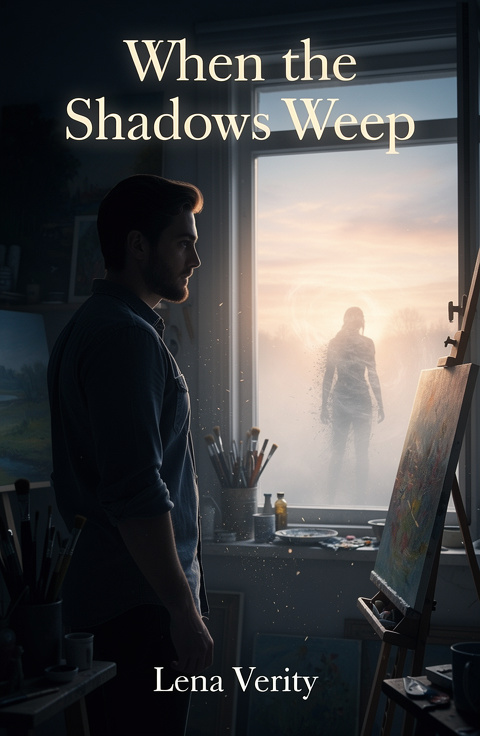
Chapter 1: Oil and Shadows
Eleanor painted only in the mornings. That was when soft, blue light pressed up against her tiny apartment window, revealing every dust mote like drifting ash. Colors behaved best in that hush, obedient to her brush. Through the window facing hers, haze often masked the world—except one silhouette. He lived in the flat opposite, perched at the edge of Eleanor’s sight.
It was his quiet, unhurried presence that first caught her. Sometimes their gazes met, and he would nod—just a flutter of acknowledgment before he vanished into the dimness of his room. Tall and pale as spring birch, rarely venturing beyond the threshold, he moved with a silence that unsettled the air between them.
Their building woke with creaks, distant televisions, and squabbling pipes. Yet he remained apart, some gentle specter slipping through cracks. She wondered about the sound of his voice, the shape of his shadow in the noon sun. Each day she set a fresh canvas, hoping he might appear in its center. The neighborhood pulsed with life, but Eleanor felt suspended, as if waiting for something beautiful and terrible to rise from the darkened window opposite hers, when the light was right.
Chapter 2: A Name in the Dark
One evening, washed in rain, Eleanor lingered by her window, palette resting heavy in her lap. She glimpsed him outside for the first time, damp hair clinging, a dark scribble against the yellowed streetlamps. He moved with careful grace, hands cradling a battered book.
Compelled by a quiet urgency, Eleanor pressed her palm to the cold glass. Their eyes met. He raised his hand, a subtle mimicry, and she felt something pass between them—a secret, silent message.
Moments later, a gentle knock startled her from reverie. When she opened the door, the hallway flickered uncertainly, shadows pooling at his feet.
“Hello,” he said, voice like wind threading through hollow wood. “I’m Lysander.”
His name lingered in the air, sweet and uncertain. He looked around her flat, at canvases crawling with blues and greys and things unsaid. The hush between them deepened, a tidal draw.
“I see you painting every day,” he murmured, the corner of his mouth tilting. “May I look?”
Eleanor nodded. Their gazes drifted to her easel. Lysander stepped inside, and already she feared what drawing him into her world might awaken—what long shadows might spill from his footsteps.
Chapter 3: Canvas Ghost
Mornings shifted as Lysander became presence and promise. He arrived with thrifted books and tea leaves, his visits always at odd hours—never quite aligning with noon or midnight, slipping through the seams of Eleanor’s routine.
When he watched her paint, silence filled the corners of her studio, deep enough to pulse. Sometimes his eyes lingered too long on the unfinished portraits crowding the walls: faceless, velvet-skinned shapes with sorrow in their postures.
Eleanor learned Lysander’s laughter was quiet, shivery as autumn dusk. His fingers, when they brushed a canvas’s edge, seemed to stir the surface with a hush of unease, as though something outside had leaned in with him. Yet in his presence, her own fears dulled and shifted, growing less distinct and more alluring.
She studied him as he gazed at her work, noting the way daylight seemed to shy from his skin, as if he were meant only for twilight. When he finally turned to her, his face was half in shadow.
“I like the way you see people,” he said softly. “Do you ever paint dreams?”
Eleanor shook her head, struck suddenly by the thought that perhaps—perhaps—she already was.
Chapter 4: Thorn and Thread
Days grew thick with the scent of oil and unspoken secrets. Lysander read aloud some evenings, voice humming low, cadenced to lost legends. His stories conjured rustling leaves and candlelit halls, and shadows would gather thickly in the corners as if summoned by language alone.
Eleanor painted him cautiously, never daring his full likeness. Fragments appeared in her work—a delicate hand, an uncertain smile, a gaze that seemed to pierce the barriers of waking. Each portrait felt haunted, rippled with something old and watchful.
Neighbors whispered in the stairwell, about the strangeness of Lysander’s flat—how it never seemed truly lived-in, how the landlord’s key never turned in his lock. Sometimes, Eleanor found herself drifting towards his door, drawn by a low humming or the ache of quiet loneliness. But always, she turned away before knocking.
One night, sleep would not find her. She peered out, searching for Lysander’s shape. Instead, she caught only a fleeting movement at his window—something tall and wrong-boned, flickering with the lamp’s dull orange. The city thrummed outside, but a colder hush pressed against her glass. She wrapped her arms around herself, longing and terror braided tight within her chest.
Chapter 5: Moths and Mirrors
With each encounter, Eleanor noticed how Lysander’s presence mingled with disquiet—a subtle trembling, like moths fluttering against a shuttered window. His reflection was absent from the teapot’s curve, his voice blurred by static when she played her old radio.
“You come alive in moonlight,” she confessed quietly one night, as they watched the city drift behind rain-streaked glass. Lysander smiled, a fragile, sidelong smile. “I sleep best when the sun is gone,” he answered, fingers tracing languid patterns on the table.
Eleanor studied her newest painting by lamplight. Lysander’s form had found its way there—a pale suggestion, not quite human, interwoven with whorls of shadow and nocturnal blue. She meant to capture his kindness, but what she unveiled felt older, a hidden ache—something no brush could soften.
That night, she dreamed of faceless crowds and Lysander reaching for her across a river of glass. She awoke with a start, heart thundering, the taste of cold water lingering in her mouth. Dawn filtered through heavy curtains, and for the first time, Eleanor felt watched—not by the city, but by the flickering darkness inside herself, stirred by love, longing, and a deepening unease she could no longer ignore.
Chapter 6: Whispers Beneath the Floorboards
The hallway felt colder now. Eleanor began to notice things—soft thumping beneath her feet at night, as if the pipes themselves were murmuring. When she pressed her ear to the floor, she heard a faint, persistent whisper. Sometimes she thought Lysander’s name was folded into the sound.
Once, while painting, her brush faltered. The air behind her prickled. She turned, expecting him, but found only the empty chair, and the suggestion of a shape dissolving in the lamplight.
Later, Lysander arrived with petals of night in his hair, looking drawn and almost luminescent. “Are you afraid?” he asked abruptly, reading the tremor in her jaw.
She hesitated, her heart rattling like an old window. “I think I should be,” she admitted, tears blooming unbidden. He reached for her hand, cold and insubstantial, yet his gaze was unbearably tender.
“There are things about me I do not wholly understand,” he whispered, voice fainter than dusk. “But I would never willingly bring you harm, Eleanor.”
His touch lingered like a chill, threading the horror of uncertainty through their fragile intimacy. She clung to the hope that love, however uncertain, might cast out the gathering dark—if only for another night.
Chapter 7: The Disappearing Room
One afternoon, sunlight spilled too generously across the courtyard, and the world sharpened. Eleanor, carrying fresh sketches, crossed the landing to Lysander’s door. She knocked, waited. The silence was thick, swallowing even her breath.
She pressed her palm to the wood, surprised by its unnatural chill. The knob gave way beneath her hand, opening onto an emptiness that stopped her heart. The room was vacated, unnaturally clean—no books, no teacups, no whisper of lived-in clutter. Curtains hung untouched, but dust jostled in the dazzle of daylight; it felt as if the world was holding its breath.
Eleanor stepped inside. The air smelled of rain and something much older, metallic and sharp. She found a slip of paper on the sill, her own name written in a tremulous hand. Beneath it, another line: “In light, I am erased.”
Dread soared inside her like a sudden tide. She retreated to her own home, unable to banish the bristling hush left in his absence. In mirrors and puddles, she sought his reflection—only to find sunlight, unbroken and indifferent, gazing back.
Chapter 8: Unquiet Portraits
Darkness crept into Eleanor’s paintings, swallowing once-brilliant blues, turning faces to masks of shadow and longing. Lysander’s presence haunted every brushstroke, as if his absence birthed new depths rather than hollow spaces.
Neighbors avoided her gaze in the halls, muttering about odd sounds—the radio crackling with feverish static, a chill in their bones as they passed her door. Eleanor stopped answering greetings, stopped opening curtains. Instead she painted through the nights, seeking him in the swirl of her linseed-slicked ghosts.
One evening, the canvas seemed to move beneath her hand, the painted Lysander blinking slowly, pain and affection tangled in his eyes. Eleanor recoiled, heart stammering a frantic hush.
“I miss you,” she choked into the darkness. “Come back, please.”
A gust of cold air swept through, rattling the windowpanes, and for a heartbeat, she felt his hand against hers—feather-light, ice-cold, impossibly real.
With trembling lips, she whispered, “I will not forget you, Lysander,” and prayed the city’s deepening darkness would carry her words to him, wherever he slipped and wandered, lost between nightfall and oblivion.
Chapter 9: The Weight of Daylight
Weeks trickled by, slow and viscous. Eleanor’s world contracted to the hush between heartbeats, the tick of brushes in water. She barely left her flat, living in the blue dimness between hope and despair.
But the world outside would not wait for her mourning; sun cut deeper each day, searing the gloom from her paint, banishing shadows to the far corners. One morning, drawn by a terrible ache, Eleanor slipped across the threshold of Lysander’s abandoned flat.
Sunlight speared the room, so bright she squinted. Where Lysander’s bed had been stood a solitary painting—her own unfinished portrait from months ago, somehow moved, its colors blistered and faded by the sun. In it, she saw herself alone, washed pale by a relentless luminance.
She traced the outline of Lysander’s touch—soft, uncertain, as lost as she. The truth settled on her skin: Some loves are only visible in shadow, and daylight is not always salvation.
She left the room gently and closed the door, carrying her silence and sorrow back into her cocoon of studio and memory.
Chapter 10: Gloaming
Summer waned. Eleanor’s grief softened, worn down by time and gentle habit. Painting became ritual again, but now, each canvas was shaded by night—a world limned in dusk, where love swayed between longing and fear.
On evenings when the wind turned, she thought she heard Lysander at her window: a whisper, a tapping, a hush that shivered through the bones of her building. She let herself believe these were signs—echoes, perhaps, of what had not been lost entirely.
Once, in twilight’s uncertain hush, she glimpsed a faint, familiar silhouette behind the opposite pane: an impossible reflection, not cast by glass or daylight but by memory and hope. He smiled—a flicker of tenderness beneath moonlit shadow. It was enough.
Eleanor stood quietly in the blue-black room, her hand pressed warm to her heart. Love had come to her as a secret, crept away as a ghost. She found comfort in painting both the gentle and the ghastly, weaving tenderness into the heart of the uncanny. In the trembling hush just before nightfall, she whispered his name—soft, beloved, unforgotten—for she knew, sometimes, love survives best in shadow.